

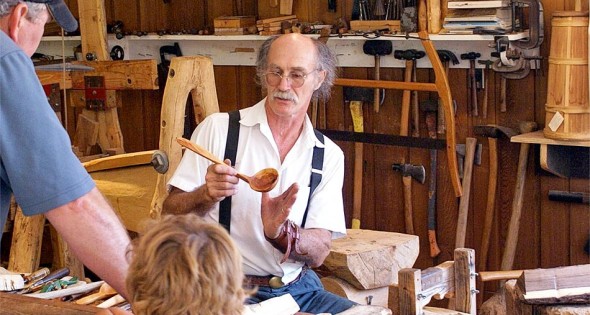
Old Is New When You’re a Folk School Student

by Mitchell Clute
Nestled in the woods outside Mountain View, Arkansas—the self-proclaimed folk music capital of the world—lies the Ozark Folk Center State Park. Its six-hundred-acre grounds contain cabins, a restaurant, a theater and a craft village, where visitors can not only purchase traditional crafts but learn to make them.
“In a nutshell, we’re here to keep the crafts, lore and music of the Ozarks alive,” says Jeanette Larson, crafts director at the Folk Center. “We do that by teaching and sharing with people, so they realize how valuable these traditions are and want to help protect them.”
A Mythical Land
Larson’s own journey to the Ozarks has the flavor of a tall tale. She and her partner were crafters who had lived on the eastern plains of Colorado for twenty years, working as farmers and shepherds, until severe drought made them reconsider their livelihood.
“In Colorado, water was something you paid for and wood something you bought at the store,” Larson tells Organic Connections. “But one day while at the Renaissance Festival, a musician told us about a mythical land called Arkansas, where water falls from the sky and wood grows on trees. So we came here, and learned he was right!”
Larson, a spinner and fiber artist, began at the Ozark Folk School teaching spinning and soon became the crafts director. Her partner entered an apprenticeship program to make craft brooms from broom corn. “He became an incredible broom maker,” says Larson. “He won the national craft broom championship in Arcola, Illinois, two years in a row!”
Living History
But broom making and fiber arts aren’t the only crafts practiced at the Ozark Folk Center. Originally founded in 1973 with the mission of providing living history and preserving the cultural and social traditions of the Ozark region, the state-funded park offers instruction in a stunning variety of crafts as well as food traditions and folk music.
For example, among the crafts taught at the center are doll making, mandolin making, farmstead cheese making, chandling or candle making, pottery, basket weaving, knife making, gunsmithing, coopery, quilting, wood carving and soap making.
“Our mission is to perpetuate these crafts—allow people to take them and make them their own,” Larson explains. Class sizes are generally small, so instruction is intimate. On the upcoming slate of classes, for instance, soap making has a limit of two; Dutch oven cookery, eighteen; and cheese making, ten. But certain programs are intended for a crowd. “Our herbalist offers a spring medicinal herb workshop that brings 170 people, where they learn to make tinctures and even distill rosemary oil,” Larson says.
All the Folk School’s teachers are experts in their crafts, not seasonal employees. “The park contracts with independent self-employed crafters, and students pay the instructors directly,” notes Larson. Many of these crafters also have their own storefronts in the craft village. The park, in turn, receives most of its revenue through the restaurant, cabin rentals and musical offerings.
Fiddles and Friends
Though crafts are a mainstay of the Ozark Folk Center’s programs, music hardly plays second fiddle. The Folk School stage hosts concerts throughout the year, annual Arkansas State Fiddle Championships, and a three-day bluegrass festival held twice a year. There are also classes and instruction for players of all levels, with an annual dulcimer jamboree and autoharp workshop focused on teaching and sharing Ozark musical traditions.
The Skillet restaurant, with walls of glass and surrounded by forest, offers diners a view of the wilderness while they eat home-cooked meals, sourced largely from local farms. “The other morning, an owl was sitting in a tree outside for the whole time I ate breakfast,” Larson marvels.
The park’s herb garden, one of the largest and most diverse organic herb gardens in the nation, is supported in part by the Committee of 100, an organization of local women dedicated to the Folk Center’s mission. This same group helps bring traditional music out of the park and into the schools. “The park pays musicians to go into local schools and teach any student, fourth grade and up, who wants to learn,” Larson says. “The Committee of 100 provides funding to give the children instruments, and some of these kids have gone on to play in Nashville and nationally.”
What brings all these people together—teachers and students, old and young, local and out of town—to learn about the foods, crafts and music of this unexplored region of the country? “It’s the community,” Larson responds without hesitation. “The people are wonderful. They really care for each other and help each other out, and it’s hard to find that in the modern world.”
To find out more, visit Ozark Folk School.








Love this story? Signup to access our free eBooks and newsletters.